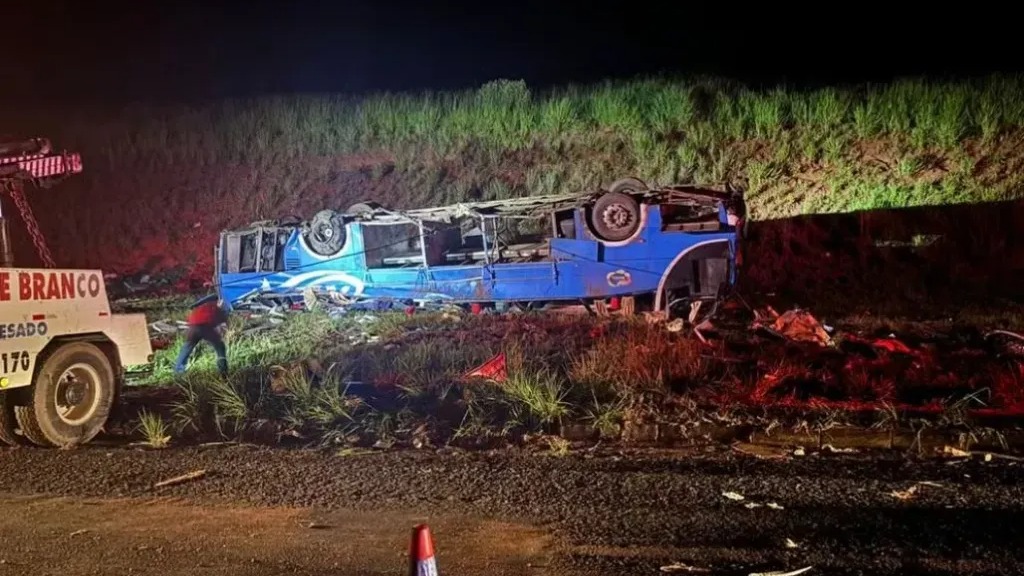
Six people are dead and dozens more injured after a charter bus packed with rural workers overturned on a federal highway in Sao Paulo state in the early hours of Sunday, February 16, 2026. The crash happened around 1:30 a.m. on the BR-153 highway near kilometer 266, between the municipalities of Marilia and Ocaucu. The passengers were seasonal farm workers from the northeastern state of Maranhao, traveling more than 3,000 kilometers south to pick apples in Santa Catarina.
According to federal highway police, a rear tire blew out on the bus, causing the driver to lose control. The vehicle veered off the road and rolled over. Six passengers were pronounced dead at the scene, and 46 others sustained injuries ranging in severity. Sao Paulo state firefighters confirmed the injured were transported to hospitals across the surrounding region for treatment.
Massive Emergency Response in Predawn Darkness
PRF units, SAMU emergency medical teams, the fire department, military police, and the highway concessionaire all converged on the crash site, treating more than 30 people on location before hospital transfers. With the wreck occurring on a dark stretch of highway between two smaller cities at 1:30 in the morning, coordination across agencies was critical to reaching the injured quickly. Local authorities reported that the Sao Paulo state government deployed Civil Defense teams for logistics and coordination with public security and health services.
The passengers had departed from Centro Novo do Maranhao, a small municipality deep in the interior of one of Brazil’s poorest states, bound for the apple orchards of Santa Catarina roughly 3,500 kilometers to the south. Routes like this are common among seasonal agricultural laborers who follow harvests across the country, spending days on buses to reach jobs that last only weeks. The BR-153, also called the Transbrasiliana, is one of the major north-south arteries these workers depend on.
Bus Was Running Without Federal Authorization
The federal highway police flagged a detail that extends the significance of this crash well beyond the wreck itself: the bus was operating without valid authorization from ANTT, Brazil’s national land transport agency, for interstate charter service. It had no passenger manifest on board. That means the vehicle was carrying dozens of workers across multiple state lines without meeting the federal licensing requirements that enforce baseline safety checks, insurance, and documentation. The PRF highlighted the irregular status, suggesting the operation may have been part of a broader pattern of informal transport linking poorer regions of Brazil to large agribusiness hubs in the south.
Seasonal rural workers in Brazil frequently depend on informal or loosely regulated charter buses to travel between regions for harvest work, often accepting whatever transport is available to secure short-term employment. These routes can cover enormous distances overnight, and the financial margins for operators can lead to deferred maintenance and fatigued drivers. A tire blowout is the kind of mechanical failure that proper pre-trip inspections are specifically built to catch. When a bus bypasses the ANTT authorization process, it also bypasses the inspections and oversight that come with it. The passengers who board these vehicles, often with little leverage and fewer alternatives, are largely in the dark about the true condition of what they are riding in.
No Passenger List Leaves Families in Limbo
The absence of a passenger manifest has created a painful information gap for families hundreds of kilometers away. With victims scattered across several hospitals in the Marilia region, officials have had to rely on survivor accounts and personal documents to confirm identities and notify relatives. For families in Maranhao and along the route south, there has been no quick way to determine whether loved ones were among the six dead or 46 injured. The Sao Paulo state Civil Police confirmed they are working to identify victims and the individuals involved, but the process has been slowed by the very documentation failures that allowed the trip to proceed in the first place.
The disaster lands less than two weeks after a separate bus crash in Alagoas state killed at least 16 people, including four children, when a vehicle returning from a religious festival overturned on a curve. In October 2025, another 17 died in a bus wreck in Pernambuco. Brazil recorded more than 10,000 traffic fatalities in 2024 according to the Ministry of Transportation. The concentration of deadly crashes involving long-distance buses has put growing pressure on federal regulators and ANTT to enforce existing rules on the routes that serve the country’s most economically vulnerable travelers. For the families of the six workers killed on the BR-153, the question of whether that pressure translates into meaningful change will define what this crash ultimately means beyond the body count.