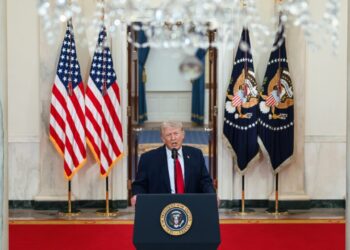
The U.S. Supreme Court has struck down President Donald Trump’s sweeping global tariffs. It ruled 6-3 that the International Emergency Economic Powers Act does not give the White House open-ended power to tax imports from around the world.
The decision is one of the biggest legal setbacks yet to Trump’s second-term trade agenda. It also redraws a line Washington has been fighting over for months: whether a president can use an emergency powers law, written for foreign threats and sanctions, as a shortcut around Congress on tariff policy.
At the center of the case was Trump’s April 2025 tariff program, which set a 10% baseline duty on imports from all countries and higher so-called reciprocal rates on many major trading partners. The administration argued the policy was justified by large and persistent U.S. goods trade deficits and could be imposed under IEEPA after the president declared a national emergency.
What the Supreme Court actually held

In Learning Resources, Inc. v. Trump, a consolidated case that also included V.O.S. Selections, the U.S. Supreme Court said the International Emergency Economic Powers Act does not authorize the president to impose tariffs. In the court’s syllabus, the justices said the statute could not be read to give the executive branch a power so broad that it would allow tariffs of effectively unlimited scope, amount and duration.
Tariffs are taxes on imported goods, and the Constitution places taxing authority with Congress. The court’s controlling opinion, announced by Chief Justice John Roberts, said the administration’s reading of IEEPA would have allowed a president to set tariff policy across much of the global trading system with little meaningful limit. The court said the statute does not extend that far.
The ruling was not a single opinion joined in full by all members of the majority. Roberts wrote the lead opinion in part. Justice Elena Kagan, joined by Justices Sonia Sotomayor and Ketanji Brown Jackson, agreed that ordinary statutory interpretation was sufficient to reach the same result on the tariff question. Justice Brett Kavanaugh dissented, joined by Justices Clarence Thomas and Samuel Alito.
The outcome, however, was clear. By a 6-3 majority, the court rejected the legal foundation Donald Trump had used for his broad emergency tariffs. The court also left intact the lower court result in V.O.S. Selections, while sending the separate Learning Resources case back with instructions to dismiss for lack of jurisdiction. In practical terms, the administration lost on the central question at issue.
How the tariff fight got here

The tariffs at issue stemmed from Donald Trump’s April 2, 2025, executive order, “Regulating Imports With a Reciprocal Tariff To Rectify Trade Practices that Contribute to Large and Persistent Annual United States Goods Trade Deficits.” In that order, Trump declared that a lack of reciprocity in trade relationships and large U.S. goods trade deficits amounted to an unusual and extraordinary threat to national security and the economy.
A same-day White House fact sheet outlined the approach. It said the administration would impose a 10% tariff on all countries and then apply higher individualized rates for countries with which the United States had the largest trade deficits.
Businesses and states quickly challenged the tariffs, arguing that the International Emergency Economic Powers Act was written to allow presidents to block transactions, freeze assets and impose sanctions in response to foreign threats, not to rewrite U.S. tariff policy from the Oval Office. In August 2025, the U.S. Court of Appeals for the Federal Circuit agreed in V.O.S. Selections, Inc. v. Trump, saying the statute did not authorize the challenged duties.
That appellate ruling gave the U.S. Supreme Court a fully developed record and a clear legal question: whether the word “regulate” in IEEPA could be interpreted to include tariffs. The justices said it could not.
Why the ruling is bigger than one tariff program

.When the U.S. Supreme Court heard arguments, the justices expressed concern about the administration’s position. As Reuters reported from the hearing, Chief Justice John Roberts told the government’s lawyer that tariffs are “the imposition of taxes on Americans” and described that as “the core power of Congress.” He also questioned whether the administration was claiming authority so sweeping that it would require clear authorization from lawmakers.
That concern runs through the ruling. If the International Emergency Economic Powers Act had been interpreted the way the administration argued, a president could have declared an economic emergency and then imposed import taxes on almost any product from almost any country for almost any length of time. The court indicated that Congress did not clearly grant that level of authority in a sanctions statute passed in 1977.
That does not mean presidents lack tariff authority. They do under other trade laws that address national security, unfair trade practices or temporary balance-of-payments measures. What the ruling makes clear is that IEEPA is not a blank check for global tariffs.
What happens next
The legal setback did not stop the administration from moving quickly. Within hours of the ruling, Donald Trump announced a temporary new 10% global tariff for 150 days and ordered fresh investigations under other statutes that could support new trade actions, according to Reuters.
That means the U.S. Supreme Court’s decision is a significant blow to Trump’s preferred approach, but not the end of the trade dispute. Businesses, importers and foreign governments now face a more complex landscape, not necessarily a tariff-free one. The struck-down International Emergency Economic Powers Act tariffs are no longer in effect, but the White House is already looking for other legal avenues to maintain pressure on trading partners.
Congress now becomes more central. If lawmakers want presidents to have clearer authority to impose broad emergency tariffs, they can provide it through legislation. If they do not, this ruling stands as a reminder that sweeping trade policy must be grounded in statutes Congress has enacted.
For consumers and companies, that distinction may sound technical, but it has real consequences. Tariffs affect prices, contracts, supply chains and investment decisions. The Supreme Court did not resolve every question about what comes next, but it did resolve one that had become central: a president cannot use IEEPA as a substitute for Congress when imposing global import taxes.