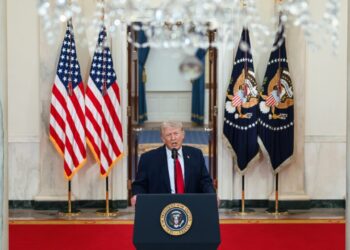
President Donald Trump turned the 2026 State of the Union into a marathon, speaking for 1 hour, 47 minutes and 40 seconds in an address that pushed the annual ritual well beyond its usual bounds. By the time he finished, the speech had become notable not only for what he said, but for how long he kept saying it.
Trump has never been known for brevity, but even by his standards this was a remarkable performance, one that stretched a prime-time address to Congress into something closer to a political endurance test for lawmakers in the chamber and viewers watching at home.
Embedded video: Full State of the Union address as published by the White House.
108 Minutes, and a New Benchmark

Donald Trump turned the 2026 State of the Union into a marathon, speaking for 1 hour, 47 minutes and 40 seconds in an address that pushed the annual ritual well beyond its usual bounds. By the time he finished, the speech had set a new modern record.
According to the American Presidency Project’s speech-length archive, Trump’s address lasted 1:47:40, the longest State of the Union in its modern tracked dataset. That pushed him past Bill Clinton’s 2000 address, which the same archive lists at 1:28:49, and well past Clinton’s 1995 speech at 1:24:58.
What Trump Tried to Do with All That time

Ahead of the address, Reuters reported that the White House had centered the speech on the theme “America at 250: Strong, Prosperous and Respected,” tying Trump’s message to the country’s approaching 250th anniversary.
Donald Trump used the extra runway to pack in nearly every element that has defined his second term so far: immigration, tariffs, inflation, energy, voting rules, AI-related electricity demand, prescription drug pricing and a long series of guest tributes and emotional set pieces. The full transcript archived by the American Presidency Project shows a speech that moved between policy claims, political taunts, crowd work and applause lines designed for television clips.
He returned repeatedly to the economy, insisting that the country had been transformed in just one year and pointing to lower inflation, cheaper gas and rising investment. He also revived familiar themes on border security and voter identification, while pressing Congress to pass the SAVE America Act and a ban on congressional stock trading. On foreign policy, he highlighted his administration’s approach to Gaza, Iran and Venezuela, framing the speech around strength abroad and order at home.
Why the Length Became the Takeaway

State of the Union speeches are intended to do several things at once. They update Congress, project authority, reassure allies, pressure opponents and give the White House a chance to distill months of governing into a single narrative. But there is usually a tradeoff. The longer the speech runs, the harder it becomes for any one message to break through.
The speech produced plenty of applause lines and a few memorable moments in the chamber, but it also risked blurring its own priorities. Even favorable coverage from the White House’s official recap leaned heavily on standout honors and guest recognitions, including tributes to military figures and members of the U.S. men’s Olympic hockey team. Coverage from The Associated Press and Reuters, by contrast, treated the record-setting runtime as one of the main takeaways because it shaped how the speech landed as much as any single policy point. Trump appeared to bet that flooding the zone would work in his favor, giving supporters a wide range of lines to celebrate and forcing opponents to choose from a long list of targets.
Not Every Claim Traveled Cleanly

The downside of a speech this expansive is that it leaves more room for disputed or exaggerated claims. That happened here. After the address, FactCheck.org said Trump’s remarks included misleading or distorted claims on the economy, immigration, crime and health care. PBS similarly flagged problems with several of the speech’s headline economic and border assertions.
Democrats used the speech’s length and tone as a line of attack, arguing that it prioritized spectacle over discipline. Even criticism that focused on policy circled back to the same point: the speech was long enough to say everything, but not tight enough to make everything stick.
The Real Significance of the Night

In the end, the strongest, safest way to understand the speech is this: Donald Trump did not just deliver another conventionally long State of the Union. He reset the modern benchmark. The American Presidency Project’s timing data shows that no other president in the modern tracked era has spoken longer in a State of the Union setting, and the speech transcript makes clear that Trump used nearly every minute to blend policy, grievance, ceremony and campaign-style performance into a single night.
Whether the address will be remembered for a signature line, a signature proposal or simply for outlasting every predecessor is a different question. For now, the most durable fact is the simplest one. Trump walked into the House chamber promising a long speech, and he left with the longest State of the Union on record.