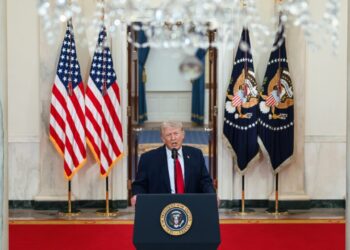
President Donald Trump moved quickly to reassert his trade agenda after the U.S. Supreme Court struck down the legal foundation for much of his sweeping tariff program. One day after the justices ruled that the International Emergency Economic Powers Act did not give him authority to impose broad import duties, Trump said he would raise a new global tariff from 10% to 15% under a different statute, signaling that the White House has no intention of backing away from a tariff-first strategy.
The announcement underscored both the administration’s determination and the uncertainty now facing businesses. The court’s ruling shut down the emergency powers theory that had supported the earlier tariff regime, but it did not eliminate other, narrower tariff authorities that can still be used. Trump’s response was to reach for one of the least-tested options available, setting up a fresh legal and economic dispute over how far the executive branch can go without Congress.
How a toy company helped bring down the old tariff framework

The legal path to this moment began with Learning Resources, the educational toy company that became the lead plaintiff in a case aimed at Donald Trump’s emergency-based tariffs. The company argued that the administration had stretched the International Emergency Economic Powers Act far beyond what Congress intended, turning a law associated with emergency sanctions into a general-purpose tariff tool.
That argument gained traction as the case moved through the courts. Importers, states and trade groups joined related litigation, while judges increasingly focused on the same central question: whether a president could use a national emergency statute to impose tariffs of sweeping size and duration with little meaningful limit. When the issue finally reached the U.S. Supreme Court, the justices ruled against the administration.
In its ruling, the court said IEEPA does not authorize the president to impose tariffs, rejecting the idea that the statute’s language about regulating importation could be read as a blank check for broad duties on goods from nearly every corner of the world. The opinion was a major setback for the White House because it struck at the heart of the legal theory that had supported Trump’s earlier tariff strategy.
The decision also carried a broader constitutional message. Tariffs are taxes on imports, and the Constitution places taxing power with Congress. The court’s ruling did not eliminate the president’s ability to use tariff laws that Congress has specifically enacted, but it made clear that the emergency powers route had gone too far. For businesses that had been paying duties under the earlier program, the ruling immediately changed the legal landscape, even if it did not provide clarity about what would come next.
Trump’s new plan relies on a different and narrower law

Rather than wait for Congress, Donald Trump turned almost immediately to Section 122 of the Trade Act of 1974. The law allows the president to impose a temporary import surcharge of up to 15% to address what the statute describes as large and serious balance-of-payments problems. It is an unusual choice for modern trade policy and one that has received far less real-world use than authorities presidents more commonly rely on, such as Section 232 or Section 301.
The first formal White House step under that law was a presidential proclamation imposing a 10% ad valorem surcharge for 150 days. The statute allows a rate as high as 15%, and Trump said the global tariff would move to that ceiling. The distinction matters: the legal paperwork initially established a 10% surcharge, while the higher number came through the president’s public announcement.
That may sound like a technical difference, but it is meaningful for companies that depend on customs instructions, published proclamations and effective dates. Importers do not price contracts based on political rhetoric alone. They need to know what has been signed, when it takes effect and which product exemptions apply.
The White House is presenting the shift as proof that the administration can keep pressing its trade agenda even after losing in court. Yet Section 122 is not a clean substitute for the International Emergency Economic Powers Act. It is narrower in purpose, explicitly temporary and subject to a 150-day limit unless Congress acts. That built-in expiration makes it far less flexible than the legal framework the administration just lost.
Why the change in legal authority matters more than the 5-point increase

Most readers will focus on the headline number, a planned increase from 10% to 15%. But the larger story is the shift in legal footing. Under the International Emergency Economic Powers Act, the administration had claimed a form of emergency authority that critics said was effectively open-ended. Under Section 122 of the Trade Act of 1974, the White House is operating with more limited authority.
That changes the risk calculation for everyone involved. A time-limited surcharge creates one kind of uncertainty, while an indefinite tariff regime creates another. Companies now know that this law carries a time limit, but they also know the administration is actively searching for other ways to keep tariffs high beyond that window. In practical terms, businesses are being told that today’s tariff structure may be temporary, but not necessarily short-lived.
It also opens the door to another round of litigation. Section 122 was written with balance-of-payments problems in mind, and economists and trade lawyers are already debating whether current conditions fit the statute as closely as the White House claims. That does not mean a challenge will immediately succeed, but it does mean the administration has traded one legal dispute for another, not found a lasting resolution.
For Congress, the moment is difficult to ignore. The U.S. Supreme Court has now narrowed one broad claim of presidential tariff power. If lawmakers are uneasy with presidents repeatedly testing older statutes in search of new tariff leverage, this is the kind of episode that could push Congress to revisit how much trade authority it has delegated over the years.
What it could mean for importers, retailers, and household budgets

A universal tariff increase does not affect the economy evenly. Retailers importing finished goods, manufacturers buying foreign components and small businesses with limited supplier options are often among the first to feel the pressure. A 5-percentage-point increase can be the difference between preserving margins and raising prices, especially in lower-margin categories such as apparel, toys, household goods and discount consumer products.
The timing matters as much as the rate. A temporary surcharge that begins late in the first quarter can affect ordering decisions for back-to-school goods and early holiday inventory planning. Some firms may accelerate shipments to avoid additional increases. Others may slow orders, renegotiate terms or shift sourcing where possible. None of those responses is without cost, and all add friction to supply chains already shaped by geopolitical risk and higher compliance costs.
Manufacturers are not insulated simply because final assembly happens in the United States. Many rely on imported inputs such as electronics, metals, machinery and specialized components. When those costs rise, the increase can ripple through the price of finished products, from vehicles to appliances to construction materials. Consumers may not see a single tariff line on a receipt, but they can still feel the effects through higher prices across a range of everyday purchases.
Smaller firms are often the most exposed. Large multinationals can spread risk across multiple suppliers and absorb regulatory shifts with dedicated trade teams. Small and midsize importers usually have less room to maneuver. When tariff rules change rapidly and legal authority remains unsettled, those businesses can end up making decisions with incomplete visibility into what the next month, not just the next year, will look like.
The broader takeaway is that the U.S. Supreme Court’s ruling did not end Donald Trump’s tariff drive. It forced a rapid rewrite of the legal framework. The previous approach is gone, but the administration has made clear it intends to keep testing what the law allows. For businesses, consumers and trading partners, that means the central question is no longer whether tariffs remain a core part of White House policy. It is how many different legal avenues the administration will pursue before it finds one that can withstand both market pressures and judicial review.