Overview Today
  • U.S.
  • Politics
  • World
    • Russia
    • China
    • Middle East
    • Europe
    • Israel
    • South America
  • Crime
  • Local
    • Dallas-Fort Worth
No Result
View All Result
SUBSCRIBE
Overview Today
  • U.S.
  • Politics
  • World
    • Russia
    • China
    • Middle East
    • Europe
    • Israel
    • South America
  • Crime
  • Local
    • Dallas-Fort Worth
No Result
View All Result
Overview Today
No Result
View All Result
Home World Middle East

United States and Israel launch coordinated military strikes against Iran

Cayla Corkill by Cayla Corkill
March 29, 2026
in Middle East, World
Reading Time: 8 mins read
0
Image Credit: The White House – Public domain/Wiki Commons

Image Credit: The White House – Public domain/Wiki Commons

74
SHARES
1.2k
VIEWS
Share on FacebookShare on Twitter

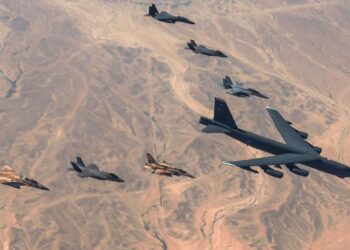
The United States and Israel launched coordinated military strikes against Iran, opening a major new phase in a confrontation that had been moving steadily toward direct war. The opening attacks hit targets in and around Tehran and other parts of the country, immediately raising the stakes for Washington, Jerusalem and the wider region. The strikes were extraordinary not only because of their scale, but because of their political consequences. Early reports said Iran’s Supreme Leader Ayatollah Ali Khamenei had been killed, a development that would leave the Islamic Republic facing its most serious leadership crisis in decades. President Donald Trump said the United States had begun “major combat operations” and warned that the campaign would continue, signaling that the first wave of strikes was not intended as a one-night show of force.

You might also like

Trump gives Iran 48-hour deadline to reopen Strait of Hormuz, warns of strikes

Israel readies possible strikes on Iran energy sites, awaiting U.S. approval

Six civilians wounded as Russia pounds Sumy Oblast With bombs, drones, and rockets

Trump frames the assault as a turning point

Image Credit: The White House - Public domain/Wiki Commons
Image Credit: The White House – Public domain/Wiki Commons

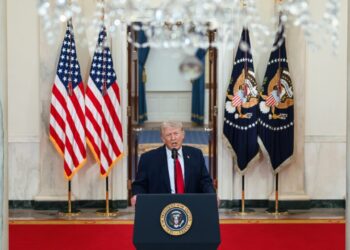
Trump announced the operation in a video statement rather than a live Oval Office address, telling Americans that U.S. forces had entered “major combat operations” against Iran. In his remarks, he cast the campaign as a response to what he described as an intolerable threat from Tehran’s missile and nuclear programs. That message set the tone for the administration’s opening case: this was being presented not as a symbolic strike, but as a military effort meant to materially weaken Iran’s ability to threaten Israel, U.S. forces and partners across the Middle East. According to Reuters, Trump celebrated the early success of the operation while cautioning that further attacks were likely. The Associated Press separately reported that the president used the video message to confirm the United States had begun military action alongside Israel. The choice of format mattered. A prerecorded message posted online gave the announcement a highly controlled feel, but it also underscored how quickly the administration wanted to define the operation before images from Iran and reactions abroad began shaping public opinion on their own.

Reports of Khamenei’s death transform the meaning of the strike

Image Credit: khamenei.ir - CC BY 4.0/Wiki Commons
Image Credit: khamenei.ir – CC BY 4.0/Wiki Commons

The most consequential early report from the battlefield was that Khamenei had been killed in the opening attack. That single development, if sustained by subsequent confirmation, would turn the operation from a major strike campaign into a direct blow against the top of Iran’s political and religious system. The AP reported that Iranian state media confirmed the supreme leader’s death after the U.S.-Israeli assault. Reuters also reported that Trump publicly celebrated strikes that killed Iran’s leader, giving the operation an unmistakable regime-level dimension even as Washington framed it around security threats. That is a critical distinction. A strike on military infrastructure can be described as coercion or deterrence. A strike that kills the country’s supreme leader inevitably invites questions about whether the real aim is to shatter the regime itself. Even if the White House prefers narrower language, the opening blow makes that debate unavoidable. It also deepens the immediate uncertainty inside Iran. The country has institutions designed to preserve continuity, but a shock of this size can still trigger confusion, internal rivalry and a scramble to project control. In the first hours after the strikes, that uncertainty was one of the most dangerous variables in the conflict because it made Iran’s next move harder to predict.

The risk now shifts from the opening attack to the response

Image Credit: Chief Petty Officer James Mullen - Public domain/Wiki Commons
Image Credit: Chief Petty Officer James Mullen – Public domain/Wiki Commons

The first day of a war rarely tells the full story. What matters next is how the target responds, how broad the campaign becomes, and whether outside powers can keep the conflict from spreading. With Iran, the danger has never been limited to one set of launch sites or one chain of command. Iran has multiple ways to retaliate directly or indirectly, from missile strikes and drone attacks to action by aligned forces across the region. That is why the opening hours of this campaign immediately put U.S. bases, Israeli cities, Gulf infrastructure and international shipping routes on higher alert. The concern is not only another exchange of airstrikes. It is the possibility that the conflict widens faster than the countries involved can control. One of the clearest pressure points is the Strait of Hormuz, the narrow waterway through which a huge share of the world’s oil and liquefied natural gas moves. A Reuters explainer noted that more than 20 million barrels of crude, condensate and fuels moved through the strait on average last year. Any serious disruption there would turn a regional war into an economic shock felt far beyond the Middle East.

Washington’s objective is still less clear than its military action

Image by Freepik
Image by Freepik

For all the force on display, the administration’s political objective remained murkier than its military one by the end of the first day. Trump described the campaign as a necessary response to Iran’s missile and nuclear capabilities. But once a joint operation kills the supreme leader, the outside world is likely to read the mission in broader terms. That ambiguity matters because different objectives require very different levels of commitment. A campaign meant to degrade missile batteries, air defenses and nuclear infrastructure is one thing. A campaign that effectively seeks to collapse or fundamentally alter the ruling system in Tehran is something much larger, and much harder to contain. That is part of why the early international reaction was so urgent. The United Nations Security Council convened as diplomats warned that the strikes could ignite a wider regional conflict. The emergency diplomacy reflected a basic reality: once Washington and Jerusalem moved from threats to direct coordinated action, the war’s consequences were no longer confined to the two governments that launched it.

A dramatic opening with no clear end in sight

Image Credit: IDF Spokesperson's Unit photographer - CC BY-SA 3.0/Wiki Commons
Image Credit: IDF Spokesperson’s Unit photographer – CC BY-SA 3.0/Wiki Commons

As an opening act, the operation was unmistakably historic. The United States and Israel did not merely hit Iranian assets. They struck at the heart of the system that has defined Iran’s regional posture for decades. That alone ensures the story will not be measured only by the damage inflicted in the first hours, but by what follows. For now, the central fact is straightforward: the United States and Israel have crossed into direct, coordinated war against Iran, and they did so in a way that appears to have decapitated the country’s leadership. What remains unclear is whether that shock produces deterrence, chaos, retaliation or some combination of all three. The answer to that question will determine whether this assault is remembered as a decisive blow or the start of a much larger and more dangerous conflict.

Share30Tweet19
Cayla Corkill

Cayla Corkill

Cayla Corkill is a writer and editor contributing news and topical coverage at Overview Today. With a background in research, fact-checking, and editorial work, she brings a detail-oriented approach to every piece she publishes. Cayla holds a Bachelor's degree from Central Methodist University and continues to grow her editorial portfolio through consistent publication work.

Recommended For You

Trump gives Iran 48-hour deadline to reopen Strait of Hormuz, warns of strikes

by Cayla Corkill
April 4, 2026
0
Image Credit: Daniel Torok - Public domain/Wiki Commons

President Donald Trump has turned the Strait of Hormuz into the next pressure point in the widening war with Iran, giving Tehran 48 hours to reopen one of...

Read moreDetails

Israel readies possible strikes on Iran energy sites, awaiting U.S. approval

by Cayla Corkill
April 4, 2026
0
Image by Freepik

Israel’s reported planning for possible attacks on Iranian energy facilities has pushed a new question to the center of the conflict: whether Washington is prepared to support a...

Read moreDetails

Six civilians wounded as Russia pounds Sumy Oblast With bombs, drones, and rockets

by Cayla Corkill
April 1, 2026
0
Shahed drone in Sumy Oblast (2024

Russian forces hit Sumy Oblast with guided aerial bombs, drones, and conventional shelling over a punishing stretch of attacks that wounded six civilians and tore through apartment buildings,...

Read moreDetails

Russia claims full control of Luhansk, but Ukraine says front lines unchanged

by Cayla Corkill
April 1, 2026
0
Image Credit: Qypchak - CC BY-SA 3.0/Wiki Commons

Russia said its troops had taken full control of Ukraine's Luhansk region. Hours later, Ukraine said the front line there had not changed. On the surface, the clash...

Read moreDetails

Colombia returns remains of legendary ELN guerrilla commander after 60 years

by Cayla Corkill
March 31, 2026
0
Statue of Camilo Torres Tenorio, Popayán 02

For 60 years, the family of Camilo Torres Restrepo never got his body back. The Colombian priest turned guerrilla fighter was killed in his first and only battle...

Read moreDetails
Next Post
Image Credit: Gage Skidmore from Peoria, AZ, United States of America - CC BY-SA 2.0/Wiki Commons

Hillary Clinton Tells House Committee She Has “No Information” on Epstein Crimes in Sworn Deposition

Browse by Category

  • China
  • Crime
  • Dallas-Fort Worth
  • Europe
  • Israel
  • Local
  • Middle East
  • Politics
  • Russia
  • South America
  • U.S.
  • World

Overview Today

Stay informed with today’s most important headlines from around the world. We bring you clear, up-to-date reports on politics, global events, crime and more — all in one place. Scan the top stories of the day and dive deeper into topics you care about.

Quick Links

  • About
  • Contact
  • Privacy Policy
  • Editorial Policy
  • Terms of Use
  • Disclaimer

Categories

  • U.S
  • Politics
  • World
  • Crime
  • Local

Signup For NewsLetter

    © 2026 Overview Today – Property of First Principles Media, LLC

    No Result
    View All Result
    • U.S.
    • Politics
    • World
      • Russia
      • China
      • Middle East
      • Europe
      • Israel
      • South America
    • Crime
    • Local
      • Dallas-Fort Worth

    Stay informed with today’s most important headlines from around the world. We bring you clear, up-to-date reports on politics, global events, culture, crime, lifestyle and more — all in one place.