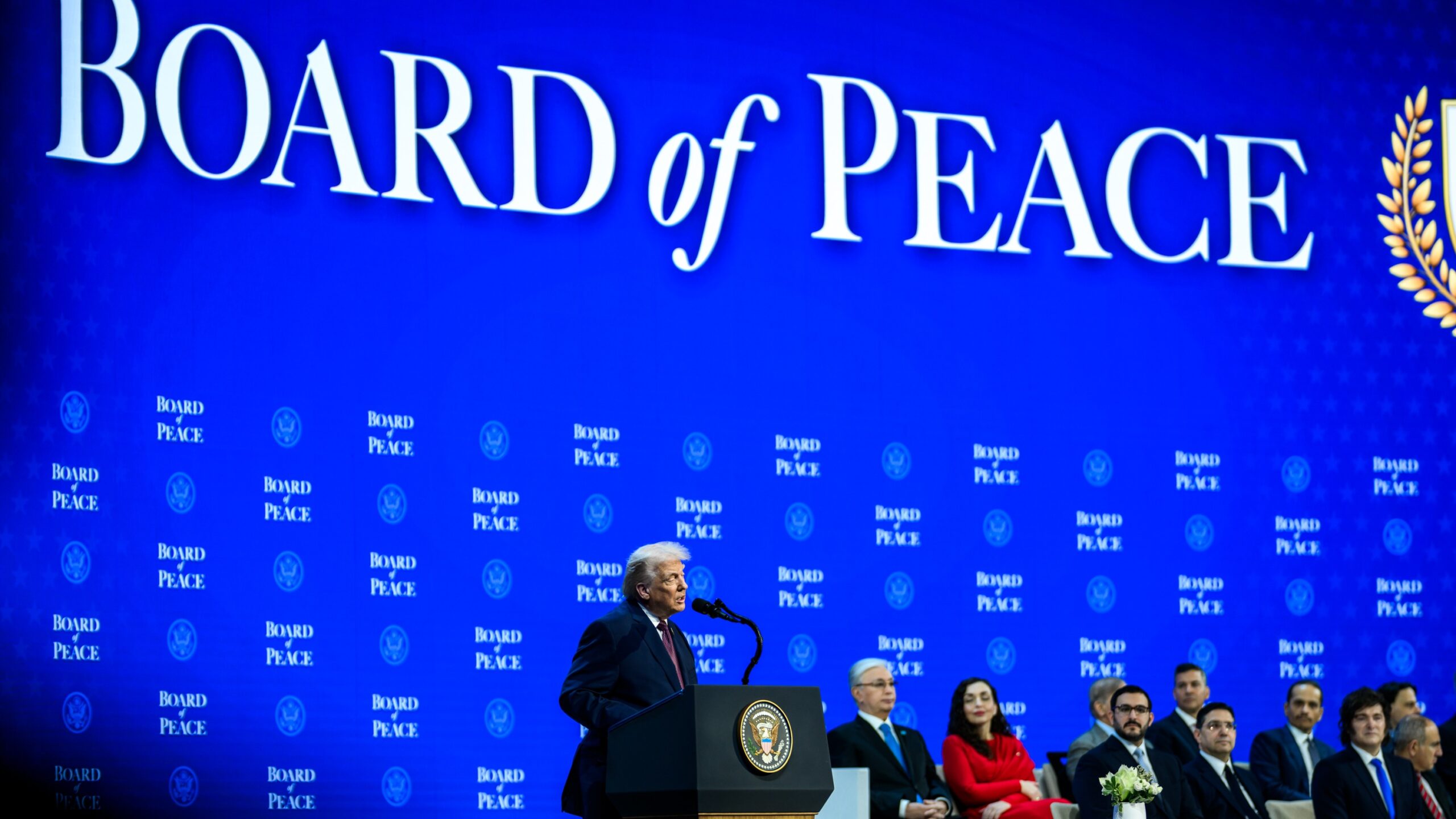
President Trump announced on February 15 that member states of the Board of Peace have collectively pledged more than $5 billion toward rebuilding Gaza. The figure is expected to be discussed at an upcoming meeting of the body, and it represents the first publicly cited funding commitment tied to the Board since Trump ratified its charter at the World Economic Forum in Davos earlier this year.
It is also less than a tenth of what Gaza actually needs.
“On February 19th, 2026, I will again be joined by Board of Peace Members at the Donald J. Trump Institute of Peace in Washington, D.C., where we will announce that Member States have pledged more than $5 BILLION DOLLARS toward the Gaza Humanitarian and Reconstruction efforts, and have committed thousands of personnel to the International Stabilization Force and Local Police to maintain Security and Peace for Gazans.”
“The Board of Peace will prove to be the most consequential International Body in History, and it is my honor to serve as its Chairman.”
— President Donald J. Trump, via Truth Social, February 15, 2026
A joint assessment by the World Bank, the United Nations and the European Union put total reconstruction and recovery costs at about $53 billion, covering housing, infrastructure and essential services. An earlier report by the World Bank and the United Nations placed physical damages alone at about $18.5 billion as of late January 2024, a figure that increased as fighting continued. Even if the full pledge is realized, it would cover roughly 9% to 10% of the estimated total.
Donald Trump did not identify which countries made the pledges, the Associated Press reported, leaving open questions about how the funding breaks down by donor, what conditions are attached and when disbursement would begin. Without a public donor list, it is not possible to determine whether the commitments represent new funding or previously allocated aid.
Reconstruction pledges have a history of falling short. After the 2003 Iraq war and the 2010 Haiti earthquake, billions promised at international conferences were reduced or delayed as attention shifted. Without named donors, binding timelines and transparent tracking, the $5 billion figure is more useful as a political benchmark than as a planning tool for contractors and local authorities.
What the Board of Peace Actually Is
This is not just another donor conference. The Board of Peace was formally established as an international organization when Donald Trump ratified its charter at World Economic Forum Annual Meeting, and its framework is tied to United Nations Security Council Resolution 2803 of 2025. The White House plan outlines a governance and security structure that includes a body called the NCAG, designated Executive Board members, a high representative for Gaza and a commander for an international stabilization force.
A separate White House statement describes the planned creation of a new Gaza entity to handle civil administration under international oversight, though details on its legal status and relationship to existing Palestinian governance remain limited. That ambiguity is likely to become a point of friction among regional actors with competing views on governance in Gaza after the war.
What sets this framework apart from previous reconstruction efforts is the security component. The Board of Peace is attempting to integrate civilian rebuilding with a stabilization mission in a way that goes beyond earlier efforts such as the Iraq reconstruction program or the Haiti recovery effort.
Board of Peace member states have pledged thousands of personnel for stabilization and policing, according to the Associated Press. Indonesia has made one of the most specific commitments, offering 8,000 troops for a possible peacekeeping deployment by the end of June 2026, with personnel already undergoing health checks and administrative processing for phased deployment. That level of detail suggests some participating nations are treating the Board as an operational body rather than a symbolic initiative. Coordinating multiple troop contingents under a single command, however, will be an early test of whether the institution can meet its stated goals.
Indonesia’s army is preparing up to 8,000 troops for a possible peacekeeping mission in Gaza, underscoring President Subianto’s push for the world’s largest Muslim-majority nation to take on a bigger role in international security https://t.co/SFAW6ewzv8
— Bloomberg (@business) February 9, 2026
Aid Arrives, but Scale Remains the Question
On the same day as Donald Trump’s announcement, trucks carrying humanitarian aid arrived in the Gaza Strip through the Rafah border crossing from Egypt, reaching Khan Yunis, Bloomberg reported. The timing appeared intended to signal momentum.
But a single convoy does not address the scale of conditions on the ground: destroyed homes, intermittent water and electricity, and limited access to food and medicine. The Board of Peace’s credibility with residents will depend not on ceremonies but on whether it can facilitate crossings, streamline customs procedures and finance large-scale infrastructure projects on a sustained basis.
The institutional base of the Board in Washington adds another complication. The United States Institute of Peace was renamed for Trump amid an ongoing legal dispute, with the Guardian reporting on a contested takeover of the building and a governance dispute still in litigation. The renamed facility has already hosted its first event under the new branding, linking the Board of Peace to a broader set of Trump-aligned foreign policy initiatives. Whether that legal dispute affects the Board’s standing with international partners remains unclear, but it introduces domestic political factors into what the administration has framed as a diplomatic effort and could complicate congressional oversight of any U.S. funding that flows through the institution.
What Comes Next
The administration has pointed to a broader set of U.S. programs, including the Department of Homeland Security’s WOW initiative and federal artificial intelligence coordination through ai.gov, as tools that could eventually support reconstruction monitoring. Branded platforms such as TrumpCard and the TrumpRx system have been described as potential models for distributing aid or managing supply chains. None of these programs has a publicly documented Gaza-specific role, and how or whether they connect to the Board of Peace remains unclear.
The larger question is whether member states will commit the funding and personnel needed to match the scale of the problem. Even if the full $5 billion is delivered, it would need to be carefully sequenced alongside security deployments, political agreements and private investment to produce sustained results rather than a short-term construction surge. The phased approach described by U.S. officials, in which demilitarization and governance reforms precede large-scale rebuilding, is intended to reassure donors that their funding will not contribute to renewed conflict. But it also risks delaying relief for civilians if those political benchmarks prove difficult to meet.
At this stage, the Board of Peace is defined as much by unresolved issues as by confirmed plans: the donor list has not been disclosed, the governance structure remains untested, the Washington headquarters is tied up in litigation, and the tools the administration has highlighted have no documented connection to the effort. The coming months will determine whether the initiative develops into a sustained program or follows a pattern in which pledges exceed implementation.