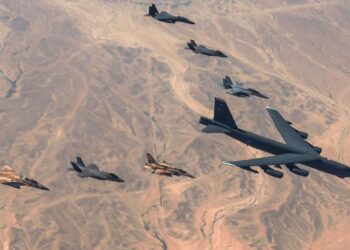
The United States and South Korea have put a key piece of their military alliance on a permanent footing, converting their combined ground command from a structure designed for wartime activation into a standing organization that now operates continuously. The move is more than a bureaucratic adjustment. It gives the allies a day-to-day framework for coordinating ground operations, planning contingencies and sharpening interoperability at a time when North Korea’s advancing missile and nuclear programs continue to dominate security planning in Seoul and Washington. It also feeds directly into South Korea’s long-running effort to assume wartime operational control of combined forces, one of the most politically sensitive and strategically important issues in the alliance.
A wartime framework becomes a permanent command

South Korean military officials disclosed in January that the Combined Ground Component Command, or CGCC, had been converted into a standing unit after approval at a bilateral Permanent Military Committee meeting in late October. The command entered operation in December, according to multiple reports from Yonhap, The Korea Times and Stars and Stripes.
Under earlier arrangements, parts of the alliance’s broader command architecture for major conflict would have to be activated or expanded as tensions rose. By turning the ground component into a standing organization, Seoul and Washington are making clear that military integration is no longer something reserved mainly for crisis. It is now meant to function every day, with a stable headquarters, regular planning cycles and a clearer command framework for combined ground operations.
The change is also significant because the standing command is led by South Korean Ground Operations Commander Gen. Joo Seoung-un, according to South Korean media reports. That leadership structure underscores how tightly the move is linked to Seoul’s push to eventually retake wartime operational control, often referred to as OPCON, from Washington under a future combined command arrangement.
Why this matters beyond symbolism

On paper, a permanent command can sound technical. In practice, it changes how an alliance works. A continuously operating headquarters allows officers from both countries to build common procedures, refine response plans, share intelligence more routinely and resolve operational questions before a crisis starts. That matters on the Korean Peninsula, where warning time could be short and where the pace of escalation can compress decision-making. A standing command helps reduce the friction that can come from having to assemble structures in the opening stages of an emergency. As South Korea’s Joint Chiefs of Staff spokesman Col. Lee Sung-jun put it, the permanent arrangement enables the allies to discuss wartime roles in advance during peacetime, allowing faster and more effective coordination, according to Stars and Stripes. The shift also gives a clearer shape to the alliance’s future. The U.S.-ROK Combined Forces Command remains the core warfighting headquarters, as U.S. Forces Korea explains, but the long-running OPCON transition has always depended on building credible structures that South Korea can lead while remaining tightly integrated with U.S. forces. A permanent ground command does not finish that transition by itself, but it makes the destination easier to see.
Freedom Shield will put the new arrangement under scrutiny

The CGCC’s conversion is separate from Freedom Shield, the annual large-scale allied exercise, but the timing makes the upcoming drills especially important. U.S. Forces Korea said Freedom Shield 26 is set for March 9 through March 19 and is designed to strengthen combined, joint, all-domain and interagency response capabilities.
This year’s exercise added weight is one of the clearest opportunities yet to see how a more permanent command arrangement performs in realistic, high-pressure scenarios that demand coordination across multiple commands and services. Reuters reported that this year’s drills are also expected to support the broader OPCON transition and include scenarios tied to deterring North Korea’s nuclear threat.
For readers in the United States, that is an important reminder of what alliance modernization actually looks like. It is not only about troop levels, missile defense systems or weapons platforms. It is also about whether the command relationships are already in place before a crisis begins.
North Korea is the direct driver, but the signal reaches wider

The immediate rationale is straightforward. North Korea’s growing missile capabilities, continued nuclear development and repeated displays of military modernization have pushed Seoul and Washington to make their command systems more responsive and less dependent on last-minute activation. A standing ground command fits that logic.
Still, the message travels beyond Pyongyang. The move shows that the alliance is investing in durable institutional integration at a time when questions about the long-term U.S. role in Asia still surface regularly. It also reflects a broader balance both sides have been trying to strike for years: South Korea taking on greater operational responsibility while the United States remains deeply embedded in planning, deterrence and command support. It gives Seoul a more visible leadership role without signaling any reduction in the U.S. security commitment.
What remains unclear
There are still important limits to what has been made public. Open reporting has established that the CGCC was approved for standing status, entered operation in December and is tied to the wider OPCON transition. But much of the finer detail remains opaque, including the full staffing structure, the exact peacetime and crisis authorities involved and how the command will fit into the future combined architecture once wartime control transition is complete. Those details matter because command relationships on the Korean Peninsula are never purely technical. They are bound up with sovereignty, political trust and decades of alliance management. Even so, the broad direction is now much easier to read. Seoul and Washington are building toward more continuous integration, not less.
A structural bet on the alliance’s future

Viewed narrowly, the establishment of a standing combined ground command is a military organizational change. Viewed more broadly, it is a structural bet on the future of the U.S.-South Korea alliance.
Temporary commands can be activated when needed. Permanent ones create habits, institutions and expectations that are harder to reverse. This shift does not just affect how the allies might fight if war ever breaks out. It shapes how they plan, train and deter every day before that moment arrives.
With Freedom Shield approaching and the larger wartime operational control transition still unfinished, the new standing command looks less like a footnote and more like one of the clearest signs yet of where the alliance is heading next.