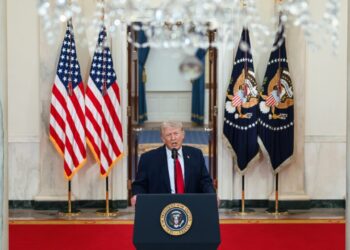
European Union leaders moved into crisis mode after President Donald Trump tied new tariff threats to his push for U.S. control of Greenland, forcing Brussels to confront a dispute that cut across trade, sovereignty and transatlantic trust. The extraordinary gathering underscored how quickly a territorial pressure campaign could spill into the economic relationship between Washington and Europe. For EU officials, the issue was not only Greenland itself, but the precedent of using trade penalties to try to bend allied governments on a geopolitical demand. That is why the bloc’s response was designed to be clear, collective and difficult to misread: Denmark and Greenland would not be left to handle the pressure alone.
Costa rallies the bloc behind Denmark and Greenland

European Council President António Costa set the tone early, framing the Greenland standoff as more than a bilateral disagreement between Washington and Copenhagen. In public remarks and a joint statement with European Commission President Ursula von der Leyen, he stressed that the European Union stood in full solidarity with Denmark and the people of Greenland, while insisting that any decisions about the territory’s future belonged to them alone. That message hardened as the pressure campaign intensified. Ahead of the emergency meeting, Costa said Trump’s threats were testing Europe’s security, principles and prosperity all at once, language that made clear Brussels saw the dispute as a challenge to the broader rules governing relations among allies, not just another trade quarrel. After the summit, the line remained unchanged: Greenland’s status was not something an outside power could negotiate through threats or leverage. Sources: European Council, AP.
Trump’s tariff threat turned a geopolitical clash into a trade crisis

The immediate trigger was Trump’s announcement that imports from eight European countries would face an additional 10% tariff beginning in February, with the rate set to rise later if the United States did not secure Greenland on terms he wanted. Reuters and AP both reported that the countries named were Denmark, Norway, Sweden, France, Germany, the Netherlands, Finland and the United Kingdom. That framing was what rattled European capitals. Tariffs are usually presented as responses to trade imbalances, subsidies or market barriers. Here, they were cast as a penalty for opposing a U.S. territorial objective. For Brussels, that moved the confrontation into much more serious territory, because it suggested that access to the American market could be used as leverage not just in commercial disputes, but in sovereignty disputes as well. Sources: Reuters, AP.
A fresh trade understanding suddenly looked fragile
The timing made the threat even more destabilizing. Only months earlier, Washington and Brussels had promoted a new framework on reciprocal, fair and balanced trade as a way to put the relationship on steadier ground. The agreement was supposed to lower friction, create more predictability and show that both sides still had an interest in managing disputes without lurching from one confrontation to the next. That is why the Greenland episode landed so hard in Europe. If a transatlantic trade framework could be followed almost immediately by tariff threats tied to a territorial demand, then the value of any new understanding came into question. European officials did not need to say the agreement was dead to make their point. The more practical worry was that any framework is only as durable as the political discipline behind it, and this confrontation exposed just how thin that sense of stability could be. Sources: White House, European Commission.
The EU has a legal instrument for economic coercion
Behind the diplomatic language sat a more concrete question: what tools does Europe actually have if tariff threats are used to force a political concession? One answer is the EU’s Anti-Coercion Instrument, the regulation adopted in 2023 to respond when a third country uses trade or investment pressure to influence the sovereign choices of the Union or one of its member states. The measure gives the European Commission a framework to investigate coercive conduct and, if necessary, propose a response that can include tariffs, restrictions on services or limits in other areas of economic access. Whether Brussels would want to deploy that instrument against the United States is another matter entirely. Doing so would be politically explosive. But the fact that the tool exists changes the texture of the standoff. Europe is no longer confined to issuing statements of concern if it concludes that economic coercion is taking place. Sources: EUR-Lex, European Commission.
Relief came quickly, but so did a deeper unease

The immediate temperature dropped when Trump later backed away from the tariff threat. That reversal gave European leaders room to avoid an outright trade fight and return, at least publicly, to the language of preserving the alliance. It also spared both sides a fast-moving rupture that could have spread well beyond Greenland. Still, the episode left behind a deeper anxiety. From Brussels to national capitals, the lesson was not simply that the crisis had been contained. It was that the transatlantic relationship can be thrown off balance with startling speed when trade tools are used for strategic pressure. Europe emerged from the confrontation showing unusual unity, but unity was only part of the story. The other part was vulnerability: even a newly refreshed trade relationship looked exposed to abrupt political shocks. That is the larger significance of the emergency summit. It was not just about rejecting one tariff threat or one demand over Greenland. It was an acknowledgment that Europe may need to think harder about how it protects its interests when a close ally begins to treat economic coercion as a routine instrument of statecraft. Sources: AP, Reuters, AP.